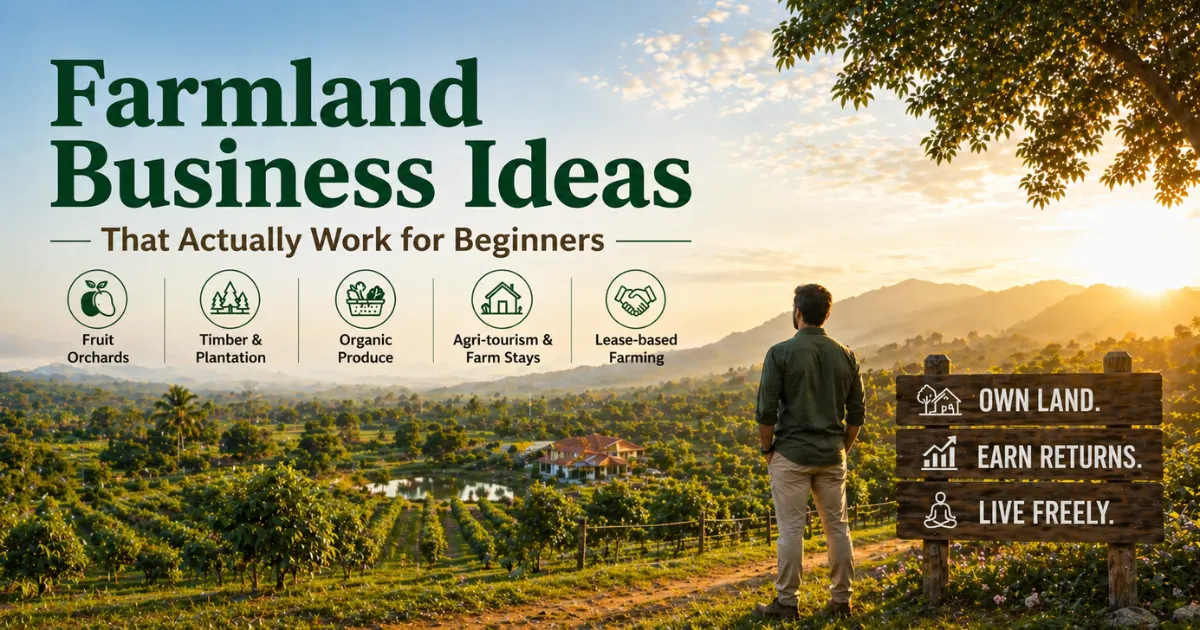
Farmland Business Ideas That Actually Work for Beginners Near Bangalore
Most people assume farmland ownership means early mornings, physical labour, and years of agricultural knowledge built from the ground up. That assumption has quietly kept a lot of good land sitting idle and a lot of interested buyers sitting on the fence.
The Bangalore South belt — Hosur, Anekal, Thally, Denkanikottai — tells a different story. The land here is fertile, well-connected, and within a manageable drive from one of India’s busiest cities. What has shifted in recent years is not the land itself but the model around it. Beginners today can own productive farmland, have it professionally managed, and build a real return from it — without leaving their current life behind to do so.
This piece lays out the business models that actually work in this region, how each one earns, and how to find the one that fits your land and your time.
You do not need to be a farmer to run a farmland business
Here is what stops most beginners: the belief that owning productive land means becoming responsible for everything that happens on it. The irrigation decisions. The crop health. The labour management. The harvest logistics. The buyer relationships.
In a managed farmland setup, none of that sits with the owner. A professional on-ground team handles the agronomy, the daily operations, and the market connections. The landowner holds a registered title, receives regular field updates, and decides how involved they want to be beyond that.
Think about the average week for someone working in Bangalore. Meetings, deadlines, family, commutes. There is no room in that week for farm operations — nor should there be. The managed model was built precisely around that reality. The land works. The team runs it. The owner benefits from what it produces and what it appreciates over time.
That is not a passive fantasy. That is how working professionals across Bangalore, Hosur, Anekal, and the broader south belt are holding and earning from farmland today.
Fruit orchard farming — earn from yield and appreciation together
A fruit orchard is one of the most practical starting points for a beginner in this region — not because it is simple, but because the land here is genuinely suited to it. The red loamy soil across Hosur, Denkanikottai, and Thally supports mango, sapota, coconut, and guava naturally. Rainfall patterns and year-round warmth in this belt mean the crops are not fighting the climate.
Mango varieties like Totapuri, Neelam, and Banganapalli are well-established in this region and move through both local markets and interstate channels consistently. Sapota is among the lower-maintenance fruit crops — tolerates dry periods reasonably well and produces steadily once the trees settle in.
How the earning works: Grafted mango and sapota trees typically begin yielding a partial harvest between years 3 and 5. Full productive output usually arrives from year 6 or 7. From that point, a maintained orchard produces for 25 to 35 years. Annual yield income comes in through each harvest season. Alongside that, the land itself appreciates — an owner sitting on a mature, producing orchard in the Hosur belt holds an asset that has grown in both productive value and market price.
Proximity to Bangalore adds a real commercial edge. Fresh, naturally grown fruit from this belt reaches the city the same day. Urban households, direct-supply networks, and organic retail channels all absorb it — and pay a premium for provenance they can trace.
For beginners who want this model without running it themselves, managed farmland near Bangalore handles everything from planting to harvest to market linkage. The owner receives the produce and the returns. The team handles the farm.
Timber and plantation farming — long horizon, low involvement
For a beginner whose priority is minimal day-to-day involvement and a long-term appreciating asset, timber and plantation farming fits well. Teak, silver oak, and bamboo grow across the Bangalore South region without intensive management once established.
Teak is a slow build — 15 to 20 years for premium-grade timber — but it suits landowners treating the holding as a generational asset. The wood holds consistent market value and the trees require very little once planted. Silver oak grows considerably faster and is often intercropped alongside fruit orchards, adding a secondary income layer without competing with the main crop. Bamboo matures within 5 to 7 years, spreads naturally, and has widening demand across construction, furniture, and biomass industries.
How the earning works: Plantation farming earns primarily through timber sale at maturity and through land appreciation over the holding period. It does not generate annual cash yield the way a fruit orchard does — the return is concentrated at the back end. For an owner who wants to plant once, maintain minimally, and come back to a significantly more valuable asset over a decade or more, this model makes sense. Combined with a managed farmlands arrangement, the land stays maintained and productive without the owner needing to visit regularly.
Organic kitchen garden and direct-supply produce — earn from the city’s appetite
Bangalore’s demand for clean, traceable, chemical-free produce has grown consistently over the last several years. Apartment communities, health-conscious households, and direct-to-consumer food networks actively look for farms they can source from reliably. A small, well-managed plot supplying organic vegetables, greens, and herbs directly into south Bangalore taps into that demand.
The Anekal belt sits closest to the city’s southeastern edge and has the shortest logistics chain for this model. A one to two acre plot managed organically with a reliable water source, a farm team experienced in chemical-free cultivation, and a basic distribution arrangement with city buyers can generate consistent monthly produce income.
How the earning works: Organic produce sold directly to households or community groups commands a meaningful premium over market-rate commodity vegetables. The income is more frequent than an orchard model — harvests happen across the growing calendar rather than once a season. The trade-off is higher operational activity. This model suits an owner who wants active monthly income from the land and is comfortable with a more engaged farm operation in the background.
Agri-tourism and farm experience days — earn from footfall, not just crops
Bangalore families with young children, groups looking for an outdoor weekend, urban professionals who want a break that does not involve a resort — all of these audiences are actively looking for what a working farm offers. The hills, open land, and clean air of the Hosur and Denkanikottai belt make this region a natural draw.
Farm experience days do not require significant infrastructure to start. A clean pathway through the land, a shaded outdoor seating area, and a structured visitor flow — walk the farm, see the crops, understand how something grows — is enough to begin. Landowners with a fruit orchard already running have an immediate advantage. A mango harvest experience in season, or a guided walk through a producing sapota grove, gives visitors something real that no manufactured attraction can replicate.
How the earning works: Weekend visitors pay a per-head entry fee or a packaged experience price. As the farm’s reputation builds through direct bookings and word of mouth, footfall grows. This becomes a secondary income stream sitting alongside the primary agricultural business — the orchard or plantation continues producing and appreciating while the visitor experience generates cash flow through the season. Owners who also have space and approvals for a farmhouse structure can extend this into overnight stays, which widens the earning model further.
Lease-based farming — earn without operating at all
For a beginner who wants no operational role whatsoever, leasing the land to an active farmer is the cleanest model available. The landowner retains full ownership and title. An experienced farmer operates the land under a structured lease, handles all cultivation decisions, and pays the owner a fixed amount or an agreed revenue share across the lease term.
This works well in the Hosur and Thally belt where there is an existing farming community with the knowledge and equipment to work the land productively. The land does not sit idle. The owner does not lift a finger operationally. The lease income arrives on schedule.
How the earning works: Lease income is typically fixed per acre per year, agreed at the start of the term. The rate varies based on land quality, water availability, and the crop the lessee intends to grow. The owner also continues to benefit from land appreciation across the lease period — when the term ends, they hold land that has grown in value while also having generated annual lease income throughout.
A well-drafted agreement is non-negotiable here. Lease terms, permitted crops, water usage limits, land maintenance standards, and exit terms all need to be clearly defined to protect the owner’s interests. . Managed farm land near Bangalore takes this structure further— the management company acts as the professional operator, the documentation is standardized, and the owner has a clear reporting relationship throughout rather than depending on an individual farmer’s reliability.
Picking the right model for your land
The right farmland business is not the most complex or the most talked-about one. It is the one that fits the land’s characteristics and the owner’s realistic availability.
Land size shapes the options. Fruit orchards work from two acres upward. Timber farming returns more at a larger scale but can start smaller. Agri-tourism needs enough open space to give visitors a genuine outdoor experience —one to three acres or more is a comfortable starting point. Lease and managed models work across most sizes.
Water availability
is the deciding factor for any crop-based model. The Hosur and Anekal belt generally has reasonable groundwater access but conditions vary plot to plot. A borewell assessment before committing to an orchard or organic produce model is time well spent. Land with dependable year-round water access opens up almost any model. Land with seasonal water constraints fits timber or lease arrangements better.
Proximity to Bangalore
determines which income models are most practical. Anekal, sitting on the city’s edge, shortens the logistics chain for direct-supply produce and makes agri-tourism day visits more realistic. Thally and Denkanikottai are further out — better suited to orchard, timber, or lease models where daily or weekly city access is not part of the earning equation.
Time and involvement
is the final question to answer honestly. An owner who can visit the land several times a year and enjoys being connected to it fits the orchard or agri-tourism model naturally. An owner who travels frequently, lives outside India, or simply wants the land to run without their involvement fits a managed or lease model. Both are valid. The model just has to match life.
Where this leaves a beginner
The farmland in Hosur, Anekal, Thally, and Denkanikottai is not waiting to be discovered. It is already working for landowners who came into it with no farming background and found a model that suited them.
The beginner’s position right now is a good one. The land is accessible, the managed infrastructure is established, and the earning models are proven across this belt. What the first-time owner needs to bring is clarity about what they want the land to do — and the patience to let the right model do it over the right timeframe.