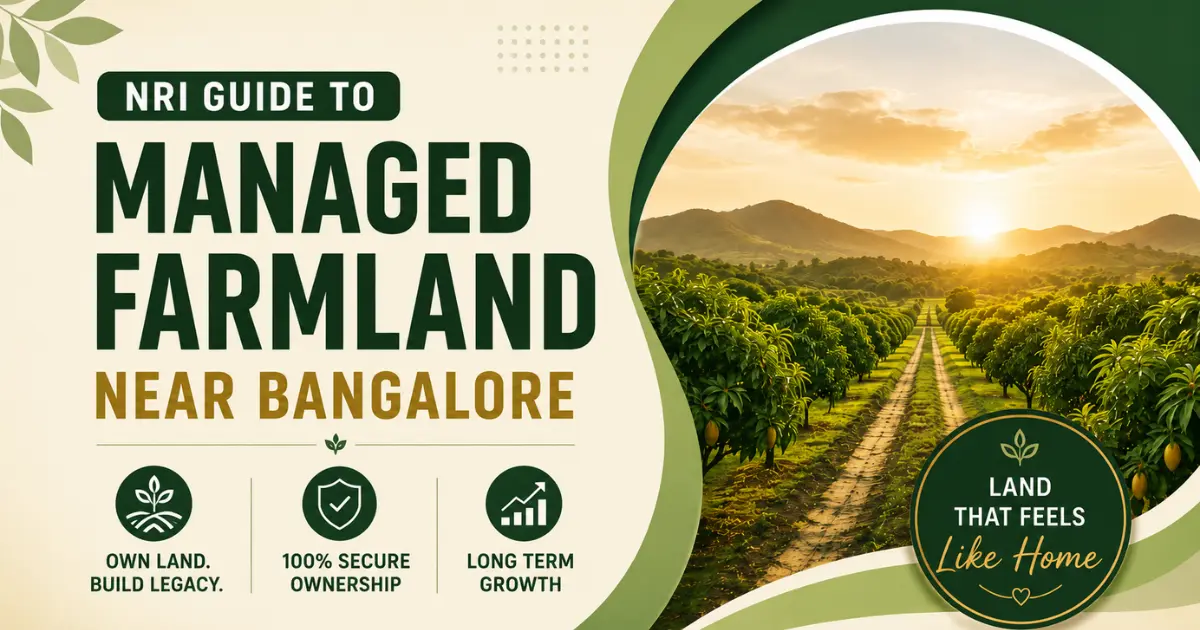
Managed Farmland Near Bangalore: An NRI’s Guide to Owning Land That Feels Like Home
There’s a particular kind of homesickness that doesn’t show up when you’re missing people. It shows up when you’re missing a place. Not your old house, not your street — just land. Open, quiet, real. The kind you can stand on and feel like you’ve gone back to something, even if you never lived there
A lot of NRIs we talk to describe this same feeling in different words. They’ve built a life abroad, the kind that looks complete on paper — a good income, a stable visa, maybe a second passport in the works. But somewhere in the middle of that, there’s this pull to own a piece of land back home. Not a flat. Not another asset in a portfolio spreadsheet. Land.
The good news is that this isn’t just sentiment chasing a feeling. Indian farmland near growing cities like Bangalore has quietly become one of the more grounded long-term investments available to NRIs — provided it’s done the right way, through the right structure. That’s what managed farmland actually is, and that’s what this guide is going to walk you through, plainly, the way you’d want someone to explain it to you.
What Managed Farmland Actually Means When You’re Not the One Managing It
Here’s the simplest way to think about it: managed farmland is agricultural land where someone else does the actual farming, while you own the land and the returns it generates.
For an NRI, this distinction matters more than it might for someone living in India. If you bought a plot of farmland on your own, you’d need someone on the ground — irrigating it, maintaining the soil, dealing with labour, handling the produce, keeping an eye on the boundary. You’re not there to do any of that. You might visit once a year, if that.
Managed farmland solves exactly this problem. A company takes care of the land’s day-to-day upkeep — the soil, the plantation, the security, the paperwork — while you hold ownership of a clearly demarcated plot with a registered title in your name. You’re not running a farm from another time zone. You’re owning land that’s being looked after professionally, the same way you might own a property that’s on rent, except here the “rent” often comes in the form of land appreciation and, in many cases, a share of what the land produces.
It’s a model built for distance. That’s really the whole point of it. This is the same model behind our managed farmland projects near Bangalore, where the land, the management, and the ownership are all structured this way from day one.
Why Bangalore’s Outer Belt, Specifically
If you’ve kept half an eye on Bangalore over the last decade, you already know the city has stopped staying within its own borders. Whitefield, Sarjapur, Electronic City — all of these were once considered “outside” Bangalore. Today they’re simply Bangalore.
That same pattern is now repeating itself further out, toward Hosur, Denkanikottai, and Thally — the belt that sits right on the Karnataka–Tamil Nadu border. This isn’t a guess about the future. It’s a continuation of something that’s already happened once.
A few things are quietly pushing this corridor forward. Hosur has built a real industrial base over the years, with manufacturing and ancillary units drawing steady employment. The road connectivity to Electronic City has improved enough that the drive no longer feels like leaving the city — it feels like a longer commute within it. And land in this belt still sits at a fraction of what comparable plots near central Bangalore would cost, simply because the city hasn’t fully caught up to it yet.
This is the part that tends to resonate with NRIs in particular: you’re not buying into a region hoping something happens. You’re buying into a region where something is already underway, at a stage where the price still reflects where it was — not where it’s headed.
Choosing What This Land Means to You
Not every NRI wants the same thing from farmland, and honestly, that’s worth sitting with for a moment before you go further. Some people want a clean, no-fuss asset that grows quietly in the background. Others want a place that doubles as a retreat — somewhere they can actually go when they’re back home. A few want both, plus the comfort of community living once they’re ready to spend more time there.
Broadly, the land in this belt tends to fall into three kinds of experiences.
- Open agricultural land, built for the long haul. This is land valued for what it is — productive soil, clear titles, and the kind of long-term holding that doesn’t ask much of you beyond patience. If your goal is straightforward appreciation with minimal involvement, this is usually where people land.
- Land shaped by what’s already growing on it. Some plots come with established plantation — mango orchards, for instance, on the kind of red laterite soil this region is known for. There’s something different about owning land that already has roots in it, literally. It carries a sense of maturity that raw open land doesn’t yet have.
- Land that’s part of a planned, liveable layout. Here, the focus shifts slightly — internal roads, organised plots, basic community infrastructure already in place. This suits people who see themselves visiting more often, or eventually building something more permanent.
- None of these is the “better” choice. They answer different questions. The honest way to figure out which one fits is to actually look at them side by side — what the soil is like, how the land is laid out, what’s already developed versus what’s still raw. Our farmland projects near Hosur and Denkanikottai are laid out across exactly these three categories, so you can compare what each one actually offers before deciding anything.
How an NRI Actually Buys This — Without the Overwhelm
This is usually the point where people brace themselves for a complicated explanation, so let’s keep this simple, because it genuinely is simpler than most expect.
As an NRI, you’re allowed to invest in this kind of structured, managed agricultural land — the route is well established and not something you’re pioneering. The process itself follows a familiar shape: you choose a plot, the legal title and land documents are verified and shared with you upfront, the purchase is registered in your name, and payments are routed through standard NRE or NRO banking channels, the same accounts you likely already use for other investments back home.
What makes this manageable from abroad is that a credible managed farmland company handles the verification and paperwork transparently, so you’re not chasing down land records or sitting in a sub-registrar’s office during a short trip home. Many NRIs complete the entire decision-making process — comparing plots, asking questions, reviewing documents — without needing to be physically present until they choose to visit.
Coming Back to What Started This
That feeling we opened with — the pull toward land, toward something real and unhurried — isn’t something you need to justify with spreadsheets, even though the numbers in this belt happen to support it well. Sometimes the most reasonable financial decisions are also the ones that quietly answer something personal.
If any part of this — the soil, the orchards, the layouts, the idea of land that’s actually being looked after while you’re away — felt like it was describing something you’ve been looking for, you can explore our current managed farmland near Bangalore, across Hosur, Denkanikottai, and Thally.
Some decisions don’t need convincing. They just need the right information at the right time.