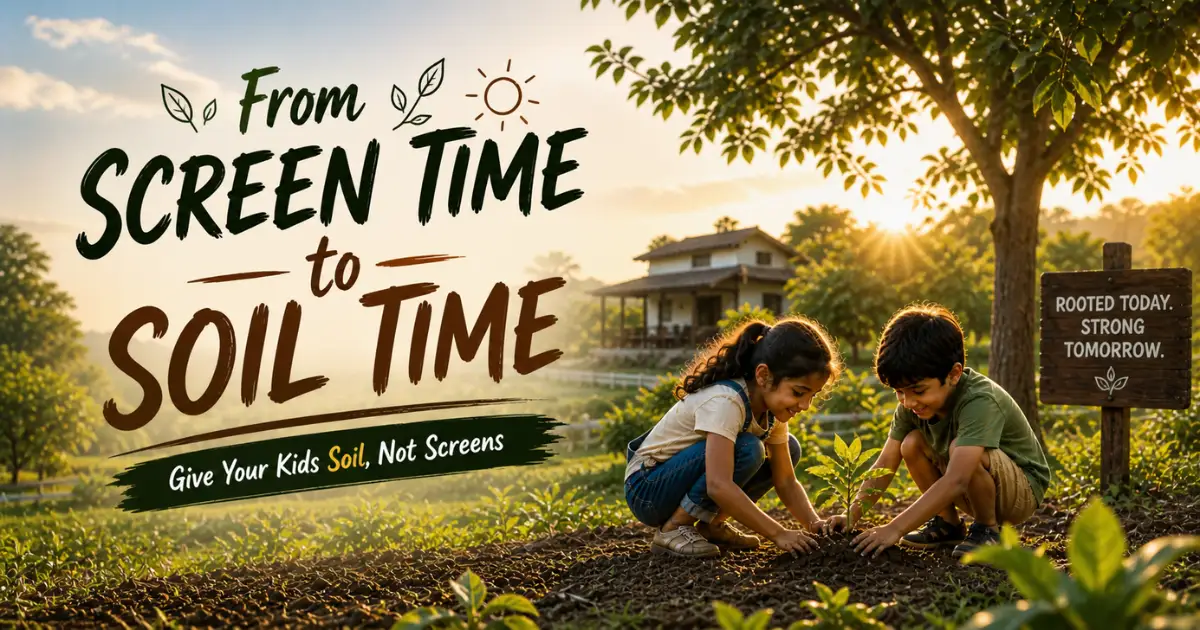
From Screen Time to Soil Time: Giving Kids Real Outdoor Experiences Near Bangalore
There is a particular kind of silence that happens when a child is handed a device. Head down. Shoulders in. The world outside — the sky, the wind, the dog, the dinner being made three feet away — completely gone.
Most parents know that silence. And most parents carry a quiet guilt about it.
Not because screens are the enemy. But because somewhere between the school runs, the work calls, and the exhaustion of a full week, the outdoor hours quietly disappeared — and nobody made a conscious decision to let them go.
This is not a piece about screen time limits or parenting philosophy. It is about something far more specific — what happens to a child when they spend time on real land. And why more Bangalore families are finding that farmland near Bangalore is giving their children something that no app, no class, and no curated activity can replicate.
What a child actually does on a farm
Not what you imagine. Not what a brochure shows. What actually happens when a child who has spent the last six months mostly indoors steps onto a working piece of land for the first time.
They pick something up. A stone, a clump of soil, a fallen leaf. They do not know why. They just do.
Then they start asking questions nobody prepared them to ask.
- Why does this soil look different from that soil?
- What is that smell?
- How long does it take for a mango tree to grow?
- Can I water this one?
- What happens if I plant a seed today — will it be here next time we come?
These are not questions that come from curiosity about a topic. They come from being physically present in something that is alive and changing. The farm does not wait for the child to be ready. It just is — and the child responds to it instinctively.
That instinct is worth paying attention to.
What screens give and what they cannot
This is not a comparison designed to make anyone feel bad. Screens give children real things — stories, creativity, connection, learning. That is true and worth saying.
But here is what screens structurally cannot give:
- Consequence — on a screen, nothing you do has a physical effect on the world around you. On a farm, if you overwater a plant it shows. If you forget to close the gate something escapes. Actions have weight.
- Patience — a screen delivers the next thing in milliseconds. A seed takes days to break the surface. A tree takes years to fruit. A child who watches that process learns something about time that no fast-moving content can teach.
- Sensory fullness — touch, smell, sound, temperature, texture. A farm activates all of it simultaneously. Screens activate two senses at most, and both of those are mediated through glass.
- Physical tiredness — the good kind. The kind that comes from using your body in an unstructured, non-competitive way. The kind that makes children sleep deeply and wake up calm.
- Ownership of something real — when a child waters a tree on land their family owns, they are not playing a game. They are tending something that belongs to them. That feeling of stewardship sits differently in a child than any achievement on a screen.
What the research says — briefly
Studies on children and outdoor exposure consistently point in the same direction. Time spent in natural environments reduces cortisol levels — the hormone associated with stress — in children. Attention spans measured after unstructured outdoor time outperform those measured after equivalent screen time. Children who regularly engage with soil and plants show stronger fine motor development and higher scores on measures of emotional regulation.
None of this requires a wilderness expedition. It requires proximity to land — and the freedom to interact with it without a structured agenda.
A working farm gives children exactly that. Not a playground with equipment. Not a nature trail with signboards. A living, productive piece of land where things are growing, things are being tended, and the child is free to be part of it.
The farm visit vs the farm visit with ownership
There is a difference between taking your children to visit a farm and taking them to a farm that belongs to your family.
A visit is wonderful. Children enjoy it, learn from it, and forget most of it within a week.
Ownership changes the relationship entirely.
When a child knows the land is theirs — or their families — the visits carry a different weight. They remember the tree they watered last time. They want to know if the mango they saw flowering has fruited yet. They start thinking in seasons. They start asking to go back.
That continuity of relationship with a piece of land is something previous generations grew up with naturally. Most children in Bangalore today have no version of it. Their world is the apartment, the school, the car, the screen. Everything outside that circuit is transient — visited and left behind.
Managed farmland near Bangalore gives urban families a way to bring that relationship back — without needing to move, without needing to farm, and without disrupting the life they have built in the city. The land is professionally managed and maintained. The family visits when they want to. The children grow up with a place that is theirs — outside the city, outside the screen, outside the routine.
What children carry from the farm back into the city
This is the part that surprises most parents the most.
It is not agricultural knowledge. It is not even the memories, though those matter.
It is the shift in how they hold themselves for a few days after a farm visit.
- They are less reactive
- They ask more questions about where food comes from
- They talk about the farm unprompted — to their friends, to their grandparents, to anyone who will listen
- They want to grow something at home — a pot, a seed, a small plant on the balcony
- They sleep better the night they come back
None of this is dramatic. It is quiet and gradual. But parents who take their children to land regularly notice it accumulates. The child who visits a farm four times a year is different — in small but visible ways — from the child who does not.
A day on the land — what it actually looks like for a family
No agenda. No schedule. Just a Saturday that belongs to a different pace.
- Morning — walk the land while the dew is still on the grass. The farm team is already working. Your children follow them, ask questions, and get in the way helpfully.
- Mid-morning — water something. Pick something. Hold soil in your hands and not immediately wash it off.
- Afternoon — sit under a tree and eat lunch that does not come in packaging. Watch how quiet it gets when you stop moving.
- Late afternoon — drive back to Bangalore with a child who is genuinely tired in a way that has nothing to do with a screen.
That is it. That is the whole thing. And it is enough.
The question worth asking
Most parents in Bangalore are working hard to give their children every advantage — the right school, the right classes, the right exposure. All of that matters.
But at the end of a childhood, what a child carries into adulthood is not the sum of their activities. It is the texture of their early years. The places they went back to. The things they tended. The mornings they remember had nothing to do with achievement.
Agriculture land near Bangalore is closer than most families realise. The land is there. The management is in place. The only thing left is the decision to give your children a place that is theirs — outside the city, outside the routine, and a long way from the nearest screen.
Soil does not need Wi-Fi to work on a child. It just needs time.