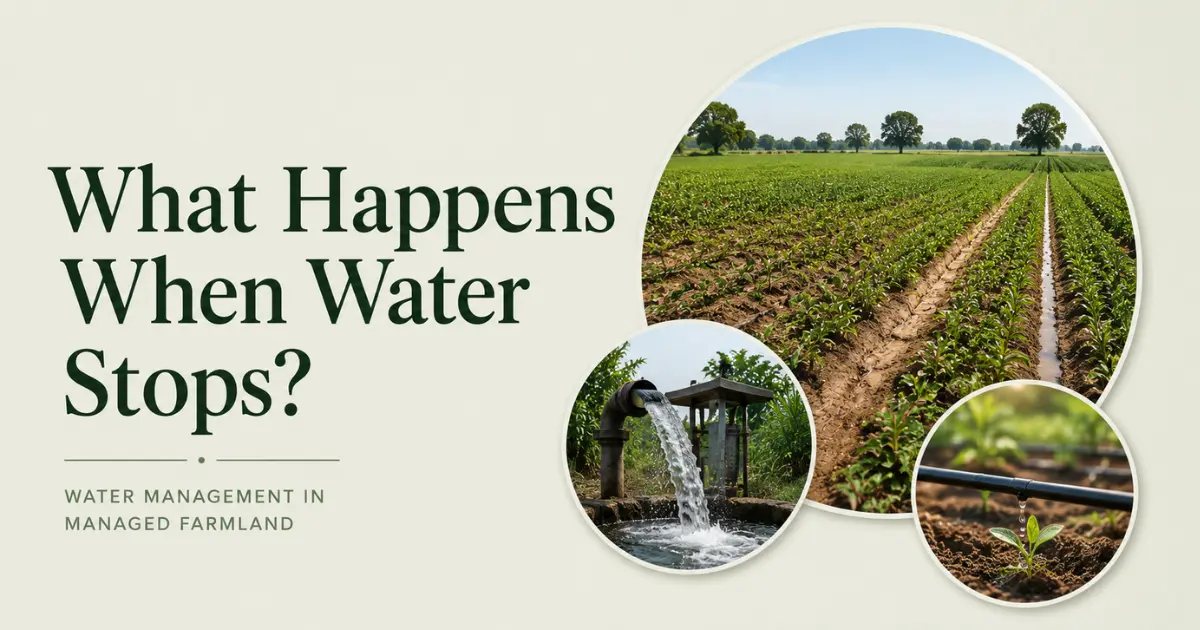
What Happens to Your Farm Plot When the Borewell Runs Dry?
A borewell’s yield doesn’t change overnight. It moves gradually, season to season, responding to rainfall, usage, and the natural rhythm of the water table beneath it. For someone buying managed farmland near Bangalore without being on site every week, understanding how that’s being tracked, and what happens if conditions shift, matters more than most people think to ask before buying.
This isn’t about alarm. It’s about understanding why water management is treated as a serious, ongoing responsibility in any well-run managed farmland operation, and what that actually looks like in practice.
Why Water Management Is Central to Managed Farmland
Every farm, regardless of region or crop, depends on a consistent water supply to function. In a managed farmland model, this isn’t left to chance or checked only when something looks wrong. It’s built into how the land is run from day one.
That typically includes:
- Drip irrigation that puts water at the root, not across the surface where most of it is lost before the plant sees it
- Borewell checks built into the regular farm schedule, not triggered only when output drops noticeably
- Irrigation timing adjusted season to season based on rainfall and crop stage, not running the same schedule year-round regardless of conditions
This corridor’s cooler temperatures and seasonal rainfall pattern mean the water table gets meaningful recharge through the year — something a well-planned farm operation works with rather than around.
What a Borewell Actually Tells You About a Plot
A borewell isn’t just a water source, it’s a record. Its depth, its yield history, and how consistently it has performed across different seasons say something about the land itself.
A plot with a borewell that has shown stable yield across multiple summers is different from one drilled recently with no track record yet. Neither is automatically a problem, but they call for different levels of attention. An established borewell with a known performance history gives a buyer something concrete to evaluate. A newer one means the management team is still building that picture, which is exactly why ongoing monitoring matters more in the early years of any plot’s development.
This is also why a single data point — “there is a borewell on this land” — tells you very little on its own. What matters is depth, current yield, how that yield has moved across seasons, and what backup measures exist if it dips.
A Solo Landowner vs a Managed Plot — What Actually Differs
This is where the real value of managed farmland plots shows up, not in the brochure, but in what happens when water needs attention.
On raw, self-managed land, water monitoring depends entirely on how often the owner visits and how closely they pay attention. For someone living in the city and visiting occasionally, gradual changes in irrigation performance can go unnoticed until they affect the crop. Arranging a fix, whether that’s adjusting irrigation scheduling or addressing a mechanical issue, then has to be coordinated from a distance, often after the fact rather than ahead of it.
On a managed plot, the irrigation lines, borewell output, and water scheduling are things someone on the ground is watching every day. If something shifts, it gets picked up as part of the week’s work, not flagged weeks later by a buyer calling from the city. Decisions about irrigation timing, maintenance, or adjustments happen as part of normal operations, not as an emergency response.
The land and the climate are the same in either case. What differs is who’s watching, how consistently, and how early a small change gets noticed before it becomes a larger one.
What Good Water Management Looks Like in Practice
A well-managed farm plot in this corridor typically includes:
- Drip irrigation as the primary delivery system, designed for efficient water use across the planted area rather than broad surface flooding
- Regular borewell checks as part of routine maintenance, not a one-time installation followed by no further attention
- Rainwater capture where feasible, making use of the region’s seasonal rainfall rather than relying on groundwater alone
- Crop and irrigation planning matched to the season, adjusting water delivery as rainfall patterns shift through the year
- Record-keeping on water performance, so any change over time is visible and addressed early rather than noticed only when it becomes obvious
None of this requires elaborate infrastructure. It requires consistency and attention applied over time rather than once at the start.
Why Crop Choice and Water Planning Go Together
Water management isn’t only about the source, it’s also about what’s being asked of it. Not every crop asks the same thing from the land. What a mango tree needs from the water table in its fifth year is a different conversation from what a row of vegetables needs through a six-week growing cycle. Planting without accounting for that difference is how farms underperform despite having adequate water on paper.
Mango suits this corridor well beyond just its climate compatibility. Once the root system is established, it draws water efficiently, especially when drip lines are delivered directly to the root zone. That’s a meaningful difference from crops that need the entire surface kept moist through their growing cycle. Vegetable crops, by contrast, typically need more frequent and consistent watering through their shorter growing cycles. A managed operation accounts for this when planning what goes where on a given plot, rather than treating every crop the same way regardless of the land’s water capacity.
The better question to ask isn’t whether there is water on the land. It’s whether the water available is being matched sensibly to what’s being grown.
Questions Worth Asking Before You Buy
A buyer evaluating any farmland projects near Bangalore should feel comfortable asking these directly:
- What irrigation system is in place on this specific plot — is it drip irrigation, and how is it maintained?
- How often is the borewell or water source checked as part of routine operations, and is there a yield record available?
- Is there any rainwater harvesting or recharge structure on site?
- How is crop choice matched to the water profile of this particular plot?
- Who is responsible for water management day to day, and how would a buyer know if something needed attention?
A project that answers these clearly, with specifics rather than vague reassurance, is one that takes water seriously — which is exactly what you want from land you’re not managing yourself.
H2O Farms is built around integrated water management — combining plot-level irrigation design, recharge systems, and ongoing monitoring — so every water detail can be reviewed directly during a site visit rather than taken on trust.
See the Water Systems for Yourself
The clearest way to understand how water is managed on a plot is to see it on the ground — walk the irrigation lines, ask about the borewell, and check the systems in place rather than just hearing about them.
Book a site visit at Sangam Farms and see how water management works across the corridor