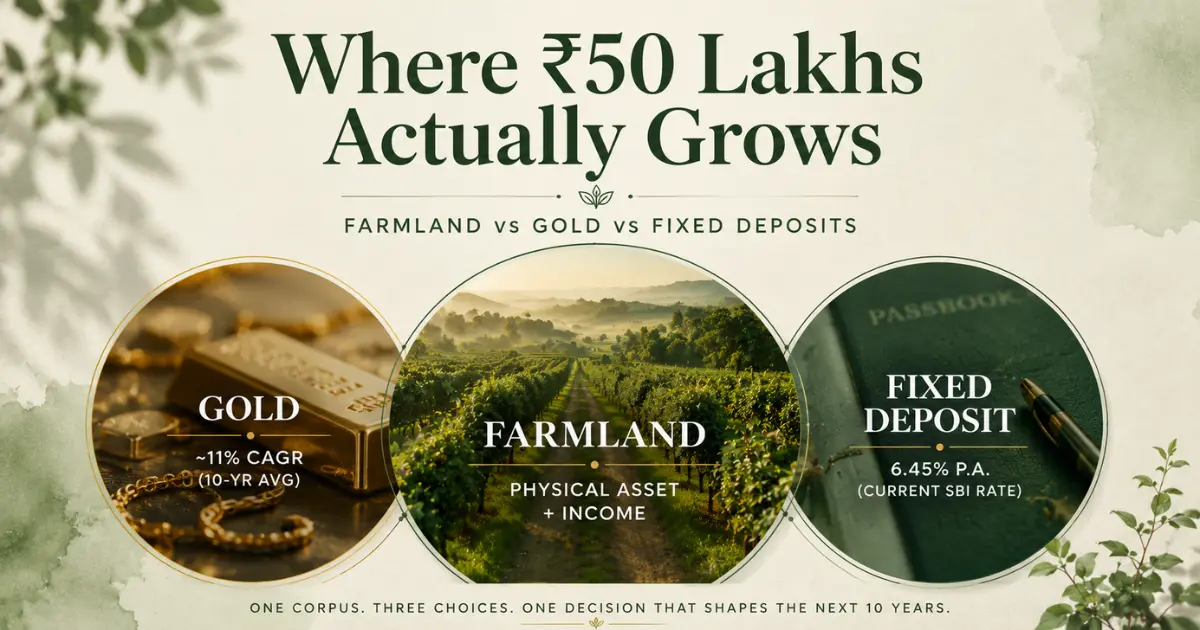
Farmland vs Gold vs Fixed Deposits: Where ₹50 Lakhs Actually Grows in 10 Years
₹50 lakhs is a number that shows up at a specific moment in life — a retirement corpus, proceeds from a sale, savings that have finally reached a point where the next decision matters. What happens to it over the next ten years depends entirely on where it goes. Three options come up in most conversations: fixed deposits, gold, and land. Each one behaves differently. Here is what the numbers actually say.
Fixed Deposits — Safe, Predictable, and Taxable
The current SBI fixed deposit rate sits at 6.45% per annum for general customers and 7.35% for senior citizens, effective December 2025. At 6.45% over ten years, ₹50 lakhs reaches approximately ₹93 lakhs before the government takes its share. FD interest isn’t treated separately — it gets added to your total income and taxed at whatever slab you fall in. For someone in the 30% bracket, the return the bank advertises and the return that actually lands in your hands are two different numbers. The effective post-tax rate works out to roughly 4.5% per annum. At that rate, ₹50 lakhs becomes approximately ₹78 lakhs over 10 years.
With India’s average inflation running between 5–6%, the real purchasing power of that maturity amount is significantly lower than the number suggests. The money is safe. It is accessible. But over a decade, it is working harder for the tax department than it is for you.
Gold — Strong Returns, No Income
Gold’s CAGR over the past 10 years in India has come in at approximately 11%. At that rate, ₹50 lakhs grows to approximately ₹1.42 crore over 10 years — a meaningful appreciation by any measure.
What the headline CAGR doesn’t show: The 11% figure is a decade-long average that masks how uneven gold’s performance actually was. There were stretches between 2010 and 2015 where gold barely moved, followed by years post-2019 where it delivered above 15% annually.
Two other things worth knowing:
- Gold generates no income during the holding period. It sits. It appreciates or doesn’t. You earn nothing from owning it until you sell.
- Capital gains tax applies on sale. Long-term gains on physical gold are taxed at 12.5% after indexation benefits under current rules.
Gold is a legitimate inflation hedge with a strong long-term track record. It is not a yield asset, and anyone treating the 2019–2025 performance as the baseline for the next decade is extrapolating from an unusually strong run.
Farmland — What the Numbers Look Like Per Square Foot
Unlike FD or gold, farmland doesn’t have a single national rate. What it has is corridor-specific, verifiable pricing that tells a different story depending on where the land sits and what’s happening around it.
In the Hosur–Denkanikottai belt:
In the Hosur corridor, land that was priced between ₹800 and ₹1,200 per sq ft in 2015 was trading between ₹2,500 and ₹5,000 per sq ft by 2025 — a movement tied directly to the manufacturing activity and workforce demand that built up in this belt over the decade.
Managed gated community farmland plots in the Denkanikottai stretch are currently listed between ₹299–₹499 per sq ft — entry-level pricing in a corridor where industrial land has already moved significantly.
In the Anekal belt:
Puravankara acquired 53.5 acres in Anekal Taluk in December 2025 with a gross development value exceeding ₹4,800 crore, identifying it as a prime residential growth corridor. That’s a Tier-1 developer committing real capital to a location that was quite semi-rural land a decade ago.
These are not return projections. They are documented price movements and current market data. What happens over the next 10 years depends on infrastructure execution, buyer demand, and corridor development — none of which can be guaranteed. What is verifiable is where these corridors stand today and what has driven their movement over the last decade.
The Tax Difference Nobody Talks About Enough
This is where farmland has a structural advantage that neither gold nor FD carries.
Any income generated from documented cultivation on agricultural land — crop sales, produce — is fully exempt from income tax under Section 10(1) of the Income Tax Act. For someone whose FD interest is being taxed at 30% and whose gold gains face capital gains tax on exit, agricultural income from their own land sits entirely outside that calculation.
Over a decade, on even a modest managed crop operation, the compounding effect of not losing 30% of income to tax every year is not a small number.
How the Three Options Compare
| Feature | Fixed Deposit | Gold | Farmland |
| Return metric | 6.45% p.a. (current) | ~11% CAGR (10-yr avg) | ₹299–₹499 per sq ft (current entry, Denkanikottai belt) |
| Post-tax return | ~4.5% at 30% bracket | 12.5% LTCG on exit | Agricultural income fully exempt |
| Income during holding | Interest (fully taxable) | None | Crop income (tax-exempt) |
| Liquidity | High | High | Low |
| Physical asset | No | Yes | Yes |
| 10-yr consistency | Predictable | Variable by period | Corridor-dependent |
Two Corridors With Documented Growth Drivers
If you’re evaluating managed farmland near Bangalore as part of this decision, two projects are worth looking at directly rather than treating farmland as a generic category.
Lakeview Farms sits in the Hosur–Denkanikottai belt — a corridor where CBRE’s 2025 report identifies Hosur as Tamil Nadu’s next growth engine, positioned at the intersection of the Bengaluru-Chennai Industrial Corridor and STRR. Tamil Nadu is also planning a 500-acre Tech City in Hosur targeting IT and ITES sectors, adding a technology layer to what was already a strong manufacturing base. The land pricing in this corridor reflects where it is today. The infrastructure pipeline reflects where it is heading.
Tamara Valley sits near Anekal — approximately 15 km from the town in the Devarabetta belt. Ten years ago, Anekal barely registered on most investors’ radar. Today it’s drawing Tier-1 developer capital — Puravankara committed ₹4,800 crore GDV to a single 53.5-acre acquisition here in December 2025 — because the combination of improving connectivity, proximity to Electronic City, and available land at sub-market pricing has changed the calculation entirely.
What ₹50 Lakhs Is Actually Buying You
This is the question behind the numbers.
In a fixed deposit, ₹50 lakhs is buying safety and predictability — with the tradeoff of a real return that barely keeps pace with inflation after tax.
In gold, ₹50 lakhs is buying a hedge against currency and market volatility — with no income from the asset during the holding period and gains that depend on when you enter and when you exit.
In farmland, ₹50 lakhs is buying a physical asset in a specific location, with tax-exempt income from cultivation and a long time horizon where the surrounding corridor’s development does a significant share of the work. The tradeoff is liquidity — this is not money you can access quickly.
None of these is the wrong choice. They suit different priorities, different time horizons, and different relationships with risk and return.
See the Land Before You Decide
Numbers on a page only take a decision so far. If farmland is part of your thinking, the next step is standing on the actual plot.
Book a site visit at Sangam Farms and see what the corridor looks like on the ground.