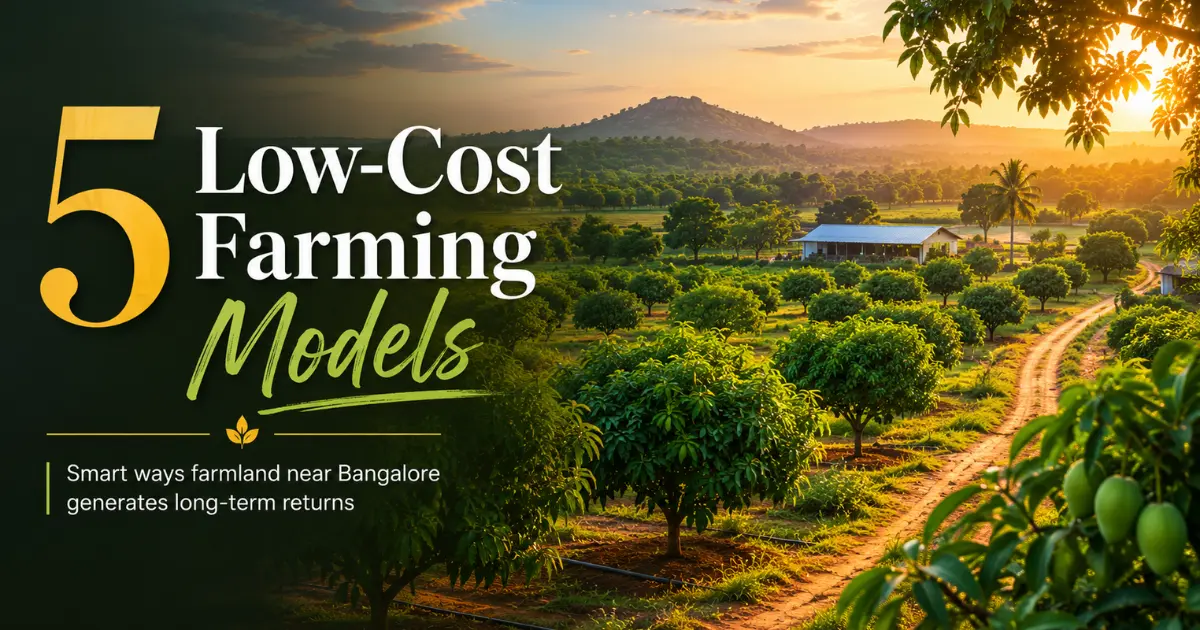
5 Farming Models That Generate Long-Term Value on Farmland Near Bangalore
The cost of farming is not just what goes in at the start. It is what the model asks from the land and the owner every year after that — in time, money, and decisions. Low-cost models are ones where that ongoing task stays manageable while the land steadily builds in productivity and value.
Five models on farmland near Bangalore consistently deliver that ratio. Each one is looked at through the lens of what it costs to run, what it produces over time, and how much the owner actually needs to be involved.
Model 1 — Perennial Crop Farming Plant once. The land earns for decades.
Most farming models ask for recurring capital — new seeds, new planting cycles, new infrastructure investments every few years. Perennial crop farming breaks that pattern entirely.
Mango and sapota, the two most established perennial crops in this region, are planted once during the establishment phase. After that, the trees grow, mature, and produce across a 25 to 40 year window with consistent agronomic care. The setup investment happens once. The annual management cost — irrigation, pruning, pest care, harvest — drops significantly once the canopy matures and stays at that lower level for the life of the orchard.
Why this model scores on cost efficiency:
- One-time establishment investment funds decades of production
- Annual maintenance cost reduces considerably after year 5 as trees mature and stabilise
- No replanting cycles mean no repeated capital outlay across the holding period
- The same trees that carry low management cost also appreciate the land beneath them
Why the return holds over time:
- Mango and sapota have consistent, year-round urban demand — Bangalore’s proximity means produce reaches buyers the same day at full freshness
- Naturally grown or organically certified fruit commands a premium in direct supply and community buying channels — the market for it has grown steadily alongside the city
- Intercropping mango with complementary crops is recommended for maximising and doubling farmer income — meaning the base orchard model already carries room to expand its output without a proportional increase in cost
The efficiency case in one line: One setup investment. Decades of output. The cost-per-year-of-production on a mature perennial orchard is among the lowest of any farming model available.
Model 2 — Intercropping Two income streams. One land cost. One management cost.
Intercropping is more efficient than monocropping and increases yield when the components utilise natural resources in ways that complement each other, generating a higher benefit-cost ratio than sole cropping. In practical terms for a landowner near Bangalore, intercropping means planting a secondary crop — banana, papaya, legumes, or vegetables — in the open spaces between a primary orchard during the years the main trees are still establishing. The secondary crop generates income during a period that would otherwise produce none. Once the primary crop matures and the canopy closes, the secondary crop phases out naturally — having already funded several years of management costs along the way.
What makes this model stand out on cost:
- The land, the irrigation, and the farm team are already in place for the primary crop — the intercrop uses that existing base at minimal additional cost
- The secondary crop covers a significant portion of annual management fees during the establishment years — the model partially finances itself
- Papaya can be grown as an intercrop in mango, litchi, and sapota plantations, while sapota farms use legumes and short-duration crops during the pre-bearing period to generate profit and fix nitrogen levels in the soil — dual benefit of income and soil improvement from the same planting
Single crop vs intercrop — what changes:
| What changes | Single crop orchard | Intercropped orchard |
| Income in years 1–4 | Minimal | Active from season one |
| Annual management cost covered by | Owner outright | Partially by intercrop income |
| Land utilisation | Moderate | High — every square foot working |
| Soil health | Standard | Improved through nitrogen-fixing intercrops |
| Management complexity | Low | Low to moderate |
The intercrop model does not add cost in proportion to the income it adds. That gap between added cost and added return is where the efficiency story lives.
Model 3 — Lease Model Zero operational cost. Two returns from one asset.
For a landowner who wants the land working without any operational role, leasing to an experienced farmer is the cleanest available path. The landowner holds a full registered title. The farmer brings the knowledge, the labour, and the crop decisions. The owner draws lease income on a fixed schedule and watches the land appreciate across the lease period simultaneously.
The input cost to the owner is maintaining the land in leasable condition — clean boundaries, functional fencing, basic infrastructure. Everything operational sits with the farmer under a structured agreement.
What a sound lease agreement covers:
- Lease term and renewal terms — typically structured in 3 to 5 year cycles
- Permitted crops and land use during the term
- Water usage and source maintenance responsibilities
- Land condition standards at handback
Why two returns run simultaneously:
Lease income arrives regardless of what the broader land market is doing. Land appreciation continues independent of the lease — the owner holds a growing asset while drawing income from it at the same time. The input-to-output ratio on this model is the strongest of any active farmland arrangement.
Working with farmland projects near Bangalore through a professional management company takes this structure further — agreements are documented, operations are overseen, and the owner receives consistent reporting rather than depending on one farmer’s word and reliability.
Model 4 — Agri-Tourism Layered on an Existing Farm No additional land. No additional crop. A new income stream from what is already there.
Bengaluru sees strong demand for short nature breaks, which is why farm stays in Bangalore have become a popular search. The global agritourism market is projected to reach USD 111.1 billion by 2032, growing at a CAGR of 12.5 percent from 2023, fuelled by rising interest in local food systems, weekend getaways, and eco-tourism.
For a landowner with a working farm already in place, agri-tourism is the most capital-efficient income addition available. The farm exists. The trees are growing. The land is maintained. Adding a visitor experience layer requires minimal additional infrastructure — a maintained pathway, a shaded outdoor area, and a clear visitor flow.
What a working farm already provides that agri-tourism needs:
- Open green space that urban families cannot access in the city
- Seasonal harvest experiences — mango picking, coconut tapping — that no manufactured attraction replicates
- A working agronomic operation that gives visitors something real to engage with
- Proximity to Bangalore that keeps the drive time within a comfortable day-trip window
Why the cost base stays low:
- The land, the crop, and the farm team are already funded by the primary farming operation
- Agri-tourism runs alongside the farm — it does not replace or compete with it
- Agritourism earnings come from three streams: stays, experiences, and food — all three are available on a working managed farm without building separate infrastructure for each
A managed farmland operation that already has professional agronomic management in place has everything agri-tourism needs as a foundation. The visitor income builds on top of what the land is already doing — at a marginal cost that a standalone hospitality investment could never match.
Model 5 — Direct Supply Organic Model Same land. Same crop. Better market channel. Stronger margin.
The organic direct supply model does not change the farming operation. It changes where the produce goes and what it earns when it gets there.
A farm near Bangalore selling its fruit and vegetables through a commodity channel earns the going market rate. The same farm supplying directly to Bangalore households, apartment communities, and organic retail channels earns a consistent premium above that rate — for the same crop, the same management, and the same land.
There is growing demand for farm-to-table ventures and locally grown organic produce near Bangalore — and that demand has a paying audience already in place across the city’s residential communities and direct-buy networks.
What makes this model low-cost:
- No additional land purchase required — the existing farm carries the model
- No crop change required — the same varieties grown for commodity sale work for direct supply
- The cost structure of the farming operation stays identical — only the distribution channel changes
- Certification for naturally grown or organic produce, where pursued, is a one-time process that opens a permanently higher-margin market
Why it generates stronger returns from the same input:
- Direct supply cuts out intermediary margins — more of what the buyer pays reaches the farmer
- Urban buyers close to the farm pay for freshness, traceability, and provenance — qualities a managed farm land near Bangalore already has by default
- Repeat buyers and subscription-based supply arrangements create predictable, consistent income rather than the variability of commodity market pricing
All 5 models — side by side
| Model | Setup cost | Ongoing cost | Income timeline | Owner involvement | Land utilisation |
| Perennial crop | One-time, medium | Low post year 5 | Year 3–5 onward | Low once established | High |
| Intercropping | One-time, medium | Low — shared base | From season one | Low to moderate | Highest |
| Lease model | Very low | Near zero | From lease start | None | Moderate |
| Agri-tourism layer | Low marginal | Low | Season-dependent | Low to moderate | High |
| Direct supply organic | None additional | Same as base farm | Immediate | Moderate | High |
What separates a low-cost model from one that just costs less
Three things determine whether a farming model genuinely earns more than it costs over a full holding period:
- Whether the setup cost is one-time or recurring — models that ask for repeated capital injections compress the return. Models built on a single establishment investment compound from a stable base.
- Whether management intensity drops or grows as the farm matures — a perennial orchard asks less of a professional team in year eight than in year two. A model that demands more input every year to maintain output is a different risk profile entirely.
- Whether the land itself does more of the work over time — established trees, healthy soil, and a proven market channel all reduce what the owner and the team need to do actively. The best models improve their own efficiency as they mature.
Each of the five models above scores well on at least two of these three. The models that score well on all three — perennial cropping and intercropping in particular — are the ones that agriculture land near Bangalore investors with a long holding horizon consistently find the most productive over time.
Which model fits your land
The right model depends on three things the owner already knows about their land:
- Water access — reliable year-round water opens up perennial cropping, intercropping, and direct supply. Seasonal water access suits the lease model or a timber-based approach until water infrastructure is built.
- Drive time from Bangalore — land within a comfortable day-trip window from the city suits agri-tourism and direct supply well. Land further out works better for lease, timber, or appreciation-focused models.
- Holding horizon — perennial cropping and intercropping reward patience. The lease model and direct supply generate income sooner with less wait. Matching the model to the timeframe the owner is actually working with determines how well the land performs across that window.